
Catron County Projected Release Dates
A projected release date is a calculation for a future custody milestone. It can move. An actual release date records an event that has already taken place. The distinction is vital for Catron County because the Sheriff’s Office transports detainees to an accepting jail outside the county. A court order may authorize release, but the accepting jail’s timestamp shows when processing ended and the person left that facility or entered another agency’s custody.
NMCD uses the exact term Projected Release Date, or PRD, for a state prison calculation. It does not mean final parole discharge. It may not even equal the day a person walks out of prison if an approved parole plan is missing. By contrast, a pretrial detainee generally has no sentence-based PRD. Bond, recognizance, a dismissal, or another court order can make release possible, yet processing and holds still affect the actual time.
| Date or event | What it means | Best source |
|---|---|---|
| Projected Release Date | NMCD’s working prison calculation | Latest OMS calculation and PRD forms |
| Court-authorized release | An order permits or directs release | District or magistrate court record |
| Actual jail release | The accepting jail ended its custody event | Jail release timestamp and disposition |
| Transfer | Custody continued with another authority | Sending and receiving agency records |
| Parole discharge | Legal supervision ended | Parole Board final order and certificate |
Find Catron County Release Dates
Start by deciding whether the person is in a county-jail path or the state prison system. Catron County does not have an established adult detention facility in the official facility map used by the research. The official county listing names Sheriff Keith Hughes, and the Sheriff’s Office can identify which jail accepted a local booking. NMCD covers people committed to state prison and people under state probation or parole, not a brief county booking that never became an NMCD case.
- For a Catron arrest, call the Sheriff’s Office with the full name, approximate arrest date, date of birth if known, and case or incident number.
- Ask which out-of-county jail accepted the booking and whether a later transport occurred.
- For a pretrial or county-sentenced person, obtain the court order and ask the accepting jail for its calculation and actual release event.
- For a state prisoner, search NMCD by name or offender number and include inactive records when checking a past release.
- If the public result lacks the date, call NMCD Inmate Records or request the latest PRD calculation and change forms.
- Follow every detainer or transfer to the receiving agency before describing the person as released to the community.
The NMCD offender search provides Last Name, First Name, Offender Number, Active, Include Inactive, Absconder Only, age, and regional controls. The public documentation promises location, offense, and supervision status. It does not guarantee that every result displays an actual release date or PRD. A missing public field should lead to a records request, not an inferred date.
The official search interface shows the exact filters available for a Catron County state-prison release-date lookup.
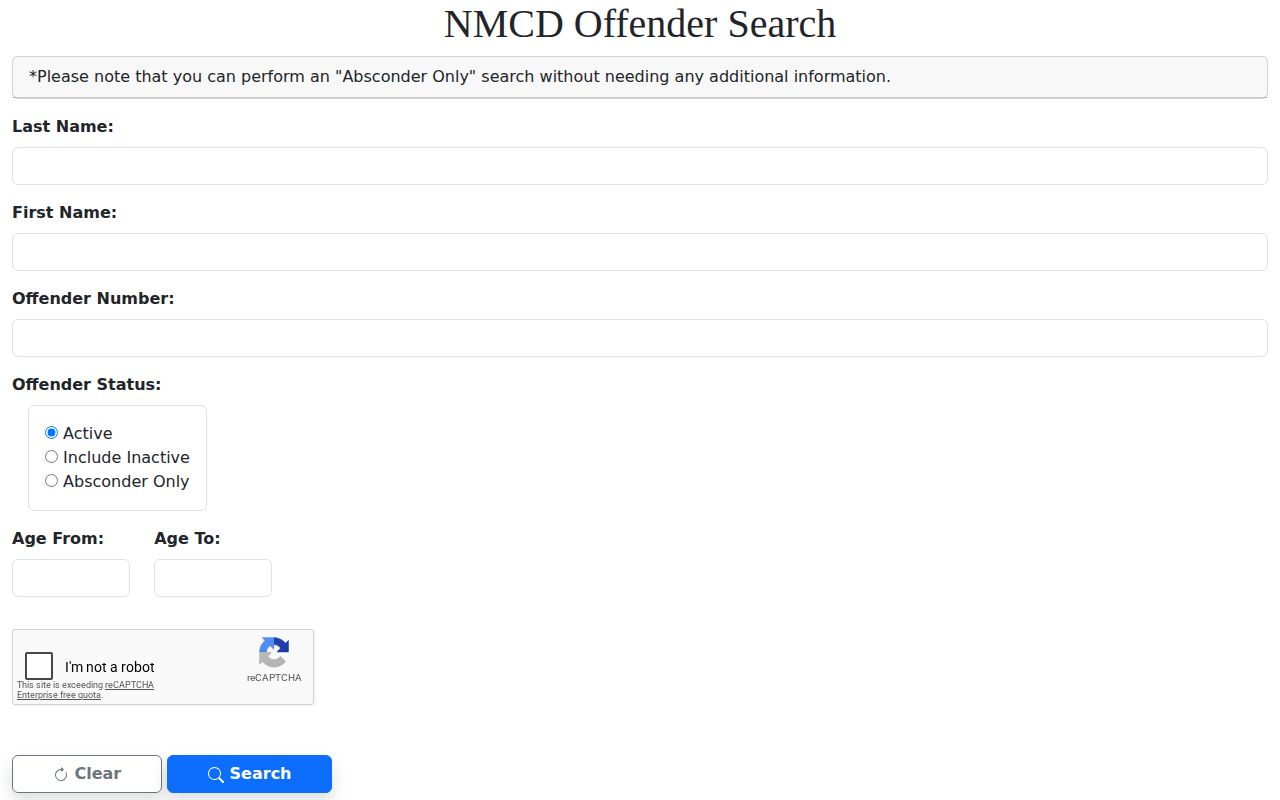
Include Inactive is especially important after discharge, while the offender number and age range help avoid a false match with another person.
Note: An empty NMCD result may reflect county-only custody, spelling, record limits, or expungement rather than a definite release.
NMCD Calculates Catron Release Dates
NMCD Offender Management Services, known as OMS, reviews the judgment and sentence, applies presentence confinement credit, and posts earned or forfeited deductions. Current policy CD-080400 establishes the agency’s exact PRD terminology. Form CD-080400.5 records the inmate name, offender number, receipt date, earned-meritorious-deduction category, days awarded, and Projected Release Date. Form CD-080400.6 records the Current PRD, New Updated PRD, and the reason for a change.
The NMCD Records and Classifications page describes OMS work on sentence and release calculations.

This source identifies the unit that resolves judgment credit, sentence-calculation, and release-date issues when a public search result is incomplete.
A focused request should name the person and offender number and ask for the latest releasable PRD calculation, Form CD-080400.5, each Form CD-080400.6, and the actual release or discharge record. NMCD lists Inmate Records at 505-690-9790, and its contact page links to the NextRequest public-record portal. Request existing electronic records. The agency need not create a new calculation or explanatory report just because a requester asks for one.
Catron Release Date Credit Rules
New Mexico’s current state-prison rule is not a broad “serve 85 percent” shortcut. Under the framework amended by final 2025 Senate Bill 375 and implemented in NMCD policy CD-080400, serious violent offenses receive four days per month of earned meritorious deductions. Other eligible offenses can receive 30 days per month. No EMD is earned during the first 60 days for a serious violent offender. Offense classification, the judgment, and the OMS calculation control the actual result.
A simple four-day-credit cycle would mean 30 days served toward 34 days of sentence, or about 88.2 percent served. Even that is only an illustration. Calendar rules, presentence credit, offense exclusions, conduct, sentence dates, and later changes can alter the true calculation. Life sentences are excluded from this policy calculation. For crimes from July 1, 1999 through July 1, 2025 involving people still incarcerated on July 1, 2025, the policy applies the new framework prospectively while preserving older accrued, lost, forfeited, or restored credits.
Earned meritorious deductions, or EMD, are sentence credits authorized by law and posted by NMCD. Continued retention can depend on program participation, attendance, rule compliance, and required labor. Qualifying failures can cause forfeiture or revocation. Restoration may be available after six months of exemplary conduct where authorized, and qualifying lump-sum awards can also move the date.
Why Catron Release Dates Change
Form CD-080400.6 lists concrete reasons for a revised PRD: low evaluation, forfeiture, lump-sum award, revocation of awarded EMD, amended judgment, and other causes. Restoration can move the date earlier. A forfeiture can move it later. A corrected award of presentence confinement credit or an amended sentence can require OMS to recalculate the term. Policy calls for written notice to the inmate when the date changes.
| Factor | Possible effect | Record to check |
|---|---|---|
| Earned deduction award | Can move PRD earlier | Form CD-080400.5 and OMS ledger |
| Forfeiture or revocation | Can move PRD later | Form CD-080400.6 and supporting action |
| Restoration or lump sum | Can move PRD earlier | Updated PRD form |
| Amended judgment | May change sentence or credit | Court judgment and OMS update |
| Detainer or hold | May block community release | Jail, NMCD, and receiving-agency records |
| Parole-plan issue | May cause in-house parole | NMCD and Parole Board records |
A detainer is a request or authority to hold or transfer a person for another agency. It does not always alter the numeric PRD, but it can stop the expected community exit. Likewise, a parole grant or sentence end does not ensure immediate gate release when the required plan is not approved. These are reasons to track both the calculation and the custody chain.
Note: The newest PRD form is more useful than an old estimate copied from a prior search or court filing.
Catron Jail and Prison Dates
The NMCD framework does not automatically calculate release from the out-of-county jail that accepts a Catron arrest. A pretrial detainee’s exit may depend on bond, recognizance, dismissal, a court order, processing time, and any other hold. A short local sentence depends on the judgment and the rules of the actual jail. Since the accepting facility varies and no Catron jail-credit policy was found, request the facility’s own calculation rather than applying the state-prison EMD rate.
For a felony case, the Catron County District Court belongs to the Seventh Judicial District, though filings go through the Socorro District Court clerk. Reserve Magistrate Court handles misdemeanor and traffic matters. A court order can explain the legal basis for release and any presentence credit. The accepting jail’s event record supplies the operational time and release code. When those dates differ, the jail timestamp resolves when its custody actually ended.
A transfer is not community release. Movement to NMCD, another county jail, the U.S. Marshals Service, or ICE continues the custody chain. If a local roster entry disappears, ask for the receiving agency and destination. The Catron County release-record workflow covers how to identify that accepting jail and request the actual event.
Confirm Catron County Actual Release
A sound release-date check uses more than one record. For a state prisoner, compare the current PRD with the actual NMCD custody status. Ask whether the person entered parole and whether an approved plan allowed physical release. For a county detainee, compare the court order with the accepting jail’s actual timestamp, release disposition, and any transfer destination.
New Mexico VINE can provide a custody-change notice tied to a selected offender and facility record. The VINE Inmate Check process is useful for a pending event, but it does not replace the jail’s exact timestamp, NMCD’s calculation, or the court order. Transfers may require a new registration. The current statewide service also has an upgrade notice, so verify availability before relying on a new search or alert.
In-house parole is another reason to check the physical status rather than the sentence date alone. Current NMCD policy uses that term when the basic prison sentence has ended but the person remains inside because an approved parole plan is not yet in place. Once a plan is accepted, the person is immediately releasable under the policy. Until then, the PRD and the prison-gate date can differ even though the calculation itself is correct.
NMCD says Adult Prisons information updates nightly and may lag by up to 24 hours. Probation and Parole information is described as real time, yet those public status fields still do not replace the underlying event records. For an exact answer, call Inmate Records at 505-690-9790 or request the latest calculation and release record. NMCD Victim Services can provide supervision status, location, and release date at 877-842-8464 during its posted weekday hours when that service fits the inquiry.
Final parole discharge comes later than prison release. On successful completion, the Parole Board’s final order and certificate of discharge are stronger proof that legal supervision ended. The three milestones should remain separate: projected or actual prison exit, the start and end of supervision, and final discharge.